Posted on Leave a comment

Hand-Cut or Laser-Cut? That is the Question!

valentine heart and doves papercut comparing hand-cut and laser-cut versions (hand-cut closeup)

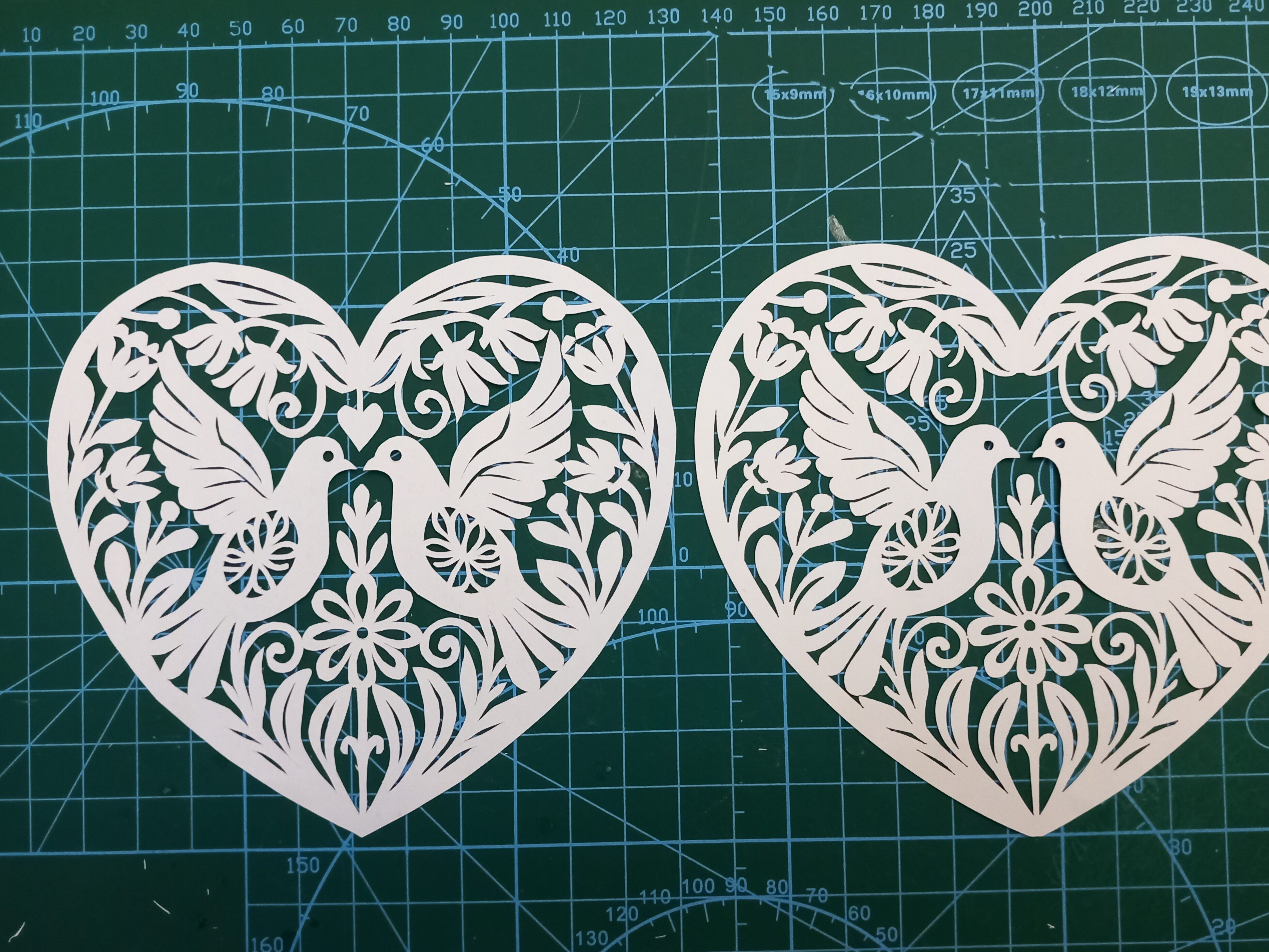
Today I put a short video on TikTok and YouTube (and a couple of other social media sites) comparing two papercuts. I asked, “Hand-Cut or Laser-Cut”? This is the design from a previous post, where I got ChatGPT/DALL-E to help me design a Valentine heart. I then cut it two different ways; by hand and by laser.

Here is a closer look at the two pieces. Can you tell which is which?:

valentine heart and doves papercut comparing hand-cut and laser-cut versions

(Before anyone mentions it – I realise I accidentally cut off the little heart above the doves’ heads in version 2. Oops!)

So…the one on the left is the hand-cut version:

valentine heart and doves papercut comparing hand-cut and laser-cut versions (hand-cut closeup)

…and here is the same section done by laser:

valentine heart and doves papercut comparing hand-cut and laser-cut versions (laser version closeup)

There is one easy way to tell them apart, without even having to look at detailed closeups. The stand-out difference is that the rightmost one is a tiny bit brown, due to smoke in the lasercutting machine. To successfully create a papercut with a laser machine, you quite often have to turn off the ‘air assist’. I might do a separate post one day on why, but the relevance here is that the smoke isn’t blown away as efficiently, so the paper goes a bit toasted.

The other main difference is usually only visible at closer range. It’s that the cutting is a bit more jagged or lumpy in some places. Having said that though, (1) it took me less than an hour to cut this one out by hand, so that explains why some parts aren’t as finished as they could be, (2) there’s nothing to stop me going back and tidying up the sharper angles if I need to.

At very close range it becomes even more obvious which is which. Lasercutting machines work by burning the paper away. So if you see (or smell!) a laser-cut piece of paper it will almost always have toasted edges. They often look like the edges of the cuts are slightly serrated, too, depending on the laser’s settings.

closeup image of a laser-cut valentine card showing two doves in a heart

Compare the laser version above with the handmade version below. The image below doesn’t have the singed brown outlines on the shapes:

closeup image of a hand-cut valentine card showing two doves in a heart

Which version is ‘better’?

I honestly can’t decide, because they both serve different purposes. If I want to do some relaxing, therapeutic papercutting as a hobby, then hand cutting is the way to go. But if I want to turn the artwork into a Valentine card, lasercutting is the best way to do that, otherwise I’d have to charge about £20 per card, which most people aren’t willing to pay. The laser gives me the ability to reproduce papercut artworks (in the same way that painters create prints of their works to put onto cards). So if someone wants one of my designs they can either go for the affordable version or the premium handmade version.

If you’d like to cut this design for yourself, I’ve adapted and created it as an SVG in my shop and Etsy shop.
Posted on Leave a comment

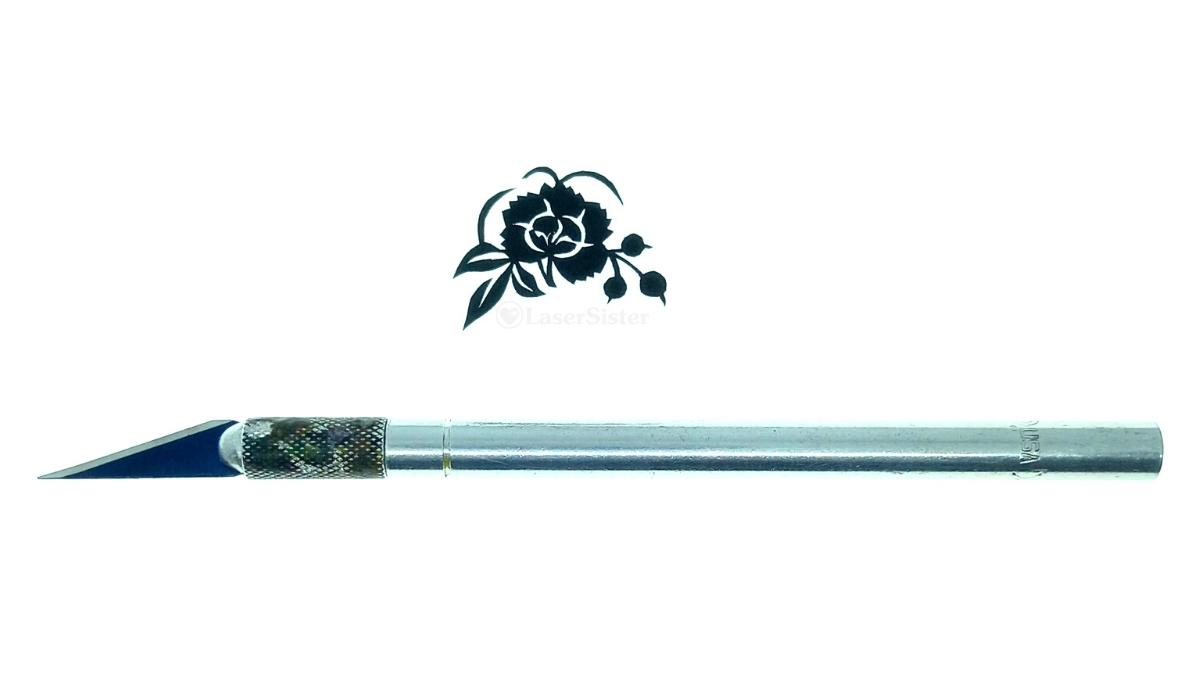
Chinese Flower (papercutting project design: 224)

papercut 224 - Chinese flower with horizontal scalpel - Kay Vincent LaserSister

This Chinese Flower design is from an ongoing papercutting project that I’ve been doing (where I’m trying to work my way through all of the designs in the “922 Decorative Vector Ornaments” book by Dover Books.)

I was doing pretty well with my papercutting during the Covid19 lockdowns, but then we had to:

  • sell our house
  • move to another part of the country
  • get new jobs
  • sell my husband’s flat
  • buy a bungalow for husband’s mother
  • rent out the bungalow because mother-in-law had a fall and couldn’t live in it
  • help m-i-l move to a care home
  • sell m-i-l’s flat
  • start renovating our new (old) house

I also had to pause my PhD. Bummer. But last I’m sort of getting on top of things, and can occasionally find time to relax and do some crafts again. So here we are with another design cut from the “922 Decorative Vector Ornaments” book. This week’s design is number 224 in the book:

papercut 224 - Chinese flower with vertical scalpel - Kay Vincent LaserSister

Closer up:

papercut 224 - Chinese flower close up - Kay Vincent LaserSister

I’ve called this one “Chinese Flower” … because it looks like a traditional Chinese papercut, and features a flower.

This piece was reeeeally small, so overall I’m pretty pleased with how it turned out. The cutting is mostly accurate and I didn’t cut off any crucial parts of the design. The only flaw that leaps out at me is the middle of the central stripe in the top leaf, where there is a little kink in the design:

papercut 224 - Chinese flower close up - Kay Vincent LaserSister

…but that’s only if I’m being super-critical. If I were that bothered by it, I could get my scalpel out and tidy it up.

In terms of the actual design, I like this one. It does have that traditional Chinese papercut style, which is something that I enjoy looking at. I could see myself using this design as part of a papercut greetings card, or maybe on wedding stationery.

While I was cutting it I was listening to one of Lee Child’s Jack Reacher books. I’ve listened to a lot of them recently and they tend to merge into each other in my memory, but I think it was One Shot. I never thought I’d get into Jack Reacher books, but then I ran out of my preferred audiobook genres in my library’s app so had to expand my repertoire. Turns out I really enjoy action/thriller type books.

Any comments? You can chip in via the comments page, or Facebook, Twitter, LinkedIn or Instagram.

Posted on 1 Comment

Lockdown Papercutting Project Day 70: Daffodil

daffodil papercut - with scalpel for scale - Kay Vincent - LaserSister

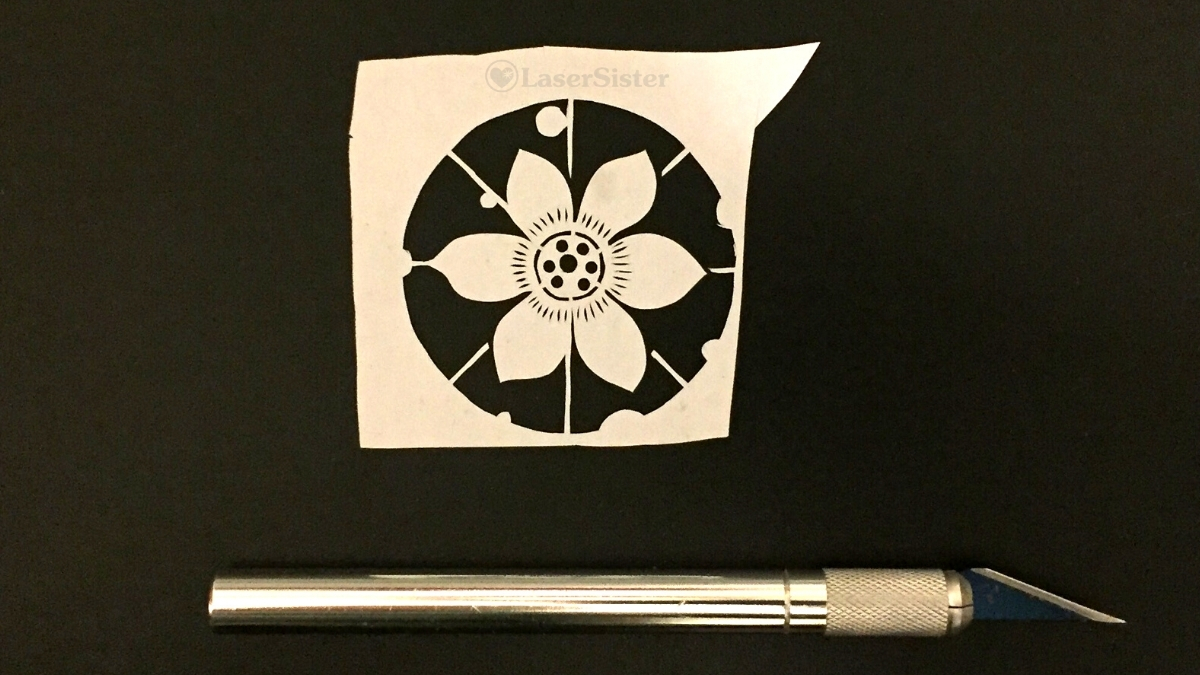
Daffodil #692

This “Daffodil” papercut is from the ongoing papercutting challenge that I’ve been undertaking for aaaaages. (Basically I’m trying to work my way through all of the designs in the “922 Decorative Vector Ornaments” book by Dover Books.)

Today’s design is number 692 in the book. As usual I’m not 100% convinced that I’ve correctly identified the flower in the design, but I had to call it something. So on the basis that it’s got 6 outer petals and could potentially be seen as having a ‘trumpet’ shape thing coming out of it (if you’re looking at it straight on), I’m sticking with the idea that it’s a daffodil. Maybe it’s a passion flower though?

daffodil papercut - with scalpel for scale - Kay Vincent - LaserSister

Closer up:

daffodil papercut - Kay Vincent - LaserSister

For this one, I sort of cheated when it came to cutting the small round holes in the centre. Because I’ve bought a tool that punches tiny holes in things. Perfect, lovely round holes. It does so much better than me just using a scalpel. But yes, it really does feel like cheating. On one hand it’s very satisfying to be able to cut small, perfect-looking circles from paper. But on the other hand, where is the skill in just punching out a circle with a tool? But on the other hand, scalpels and pairs of scissors are also cutting tools, aren’t they?

I seem to have left this papercut in a fairly rough state, apart from the nice circles. The bigger (white) circles outside the flower itself could definitely do with trimming and neatening a bit.

I don’t think I’ll be using this particular motif again in any papercutting projects, but as always, I’m pleased to have used this one as a practice piece.


Does that look like a daffodil to you, or could it be something else? Is it cheating to use a circle-punching tool, or is it OK? Feel free to use the comments page, or Facebook, Twitter, LinkedIn or Instagram.

Posted on Leave a comment

Lockdown Papercutting Project Day 69: Leaf Heart

Leaf heart papercut with horizontal scalpel for scale - Kay Vincent - LaserSister

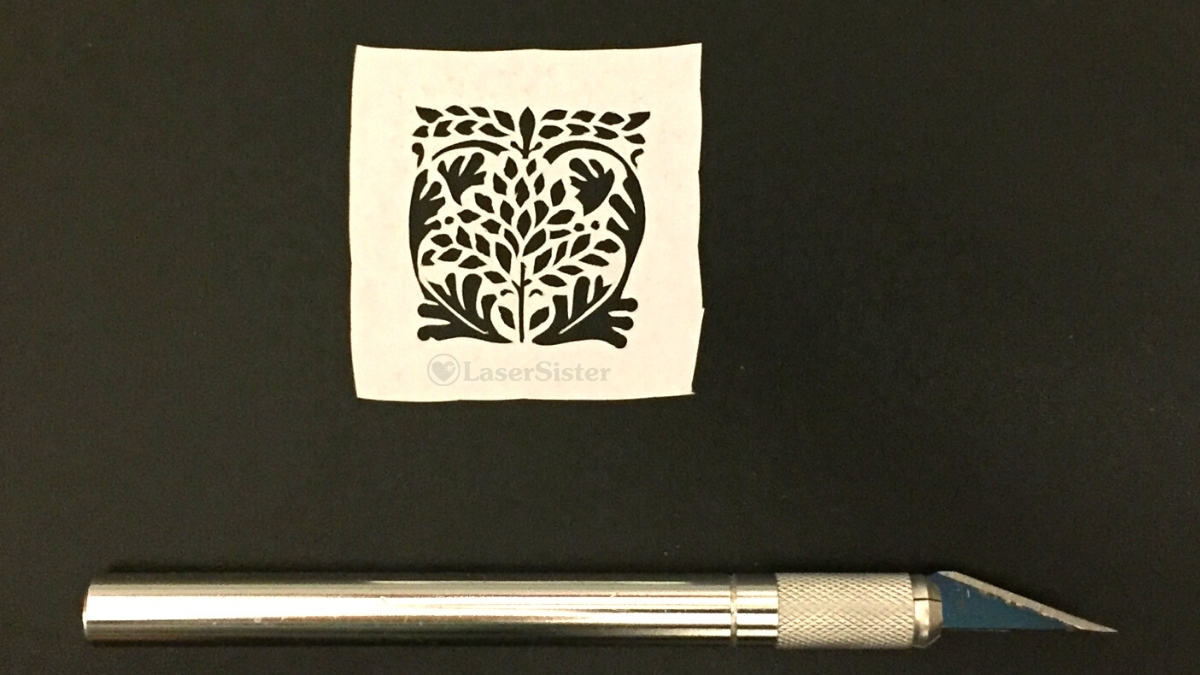
Leaf Heart #687

“Leaf Heart” is from an ongoing papercutting project that I’ve been doing. (Basically I’m trying to work my way through all of the designs in the “922 Decorative Vector Ornaments” book by Dover Books.)

Today’s design is number 687 in the book. I wasn’t sure what to call this one, but because it’s got leaves in and a bit of a heart shape, that’s why I’ve given it the title “Leaf Heart”.

Leaf heart papercut with scalpel for scale - Kay Vincent - LaserSister

Closer up:

Leaf heart papercut closer up - Kay Vincent - LaserSister

Closer up there are some shapes that are like a cross between oak leaves and rubber gloves. It’s a good job I noticed the heart shape in this design, otherwise it might have ended up being called “rubber glove oak leaves”.

This one was fun to cut and didn’t take long. But as with yesterday’s cut, I prefer the ‘positive’ designs rather than the stencil-type shapes cut out of the paper.

There are a couple of the shapes where I could have trimmed them a bit better, but on the whole I think the cutting was pretty accurate.


In the background I’m still listening to the audio book of Duskfall, and the narration is still annoying.


Any comments? You can chip in via the comments page, or Facebook, Twitter, LinkedIn or Instagram.

Posted on Leave a comment

Lockdown Papercutting Project Day 68: Rose Border

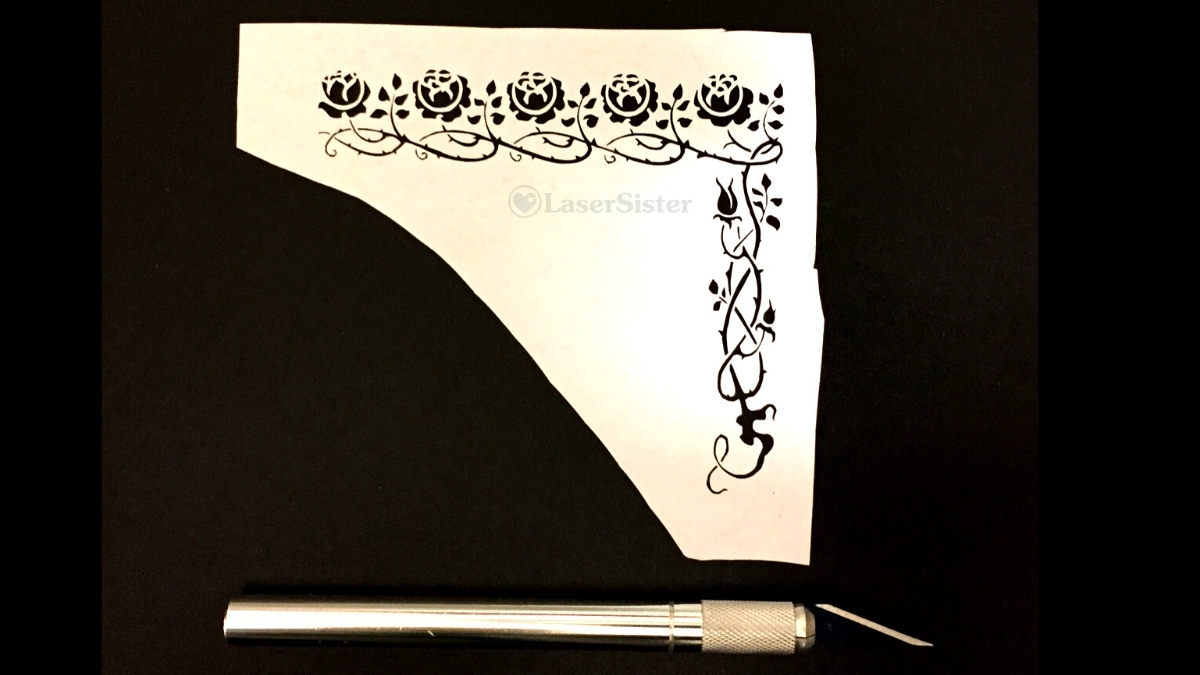
Rose Border #679

“Rose Border” is from the ongoing papercutting project that I’ve been doing. (Basically I’m trying to work my way through all of the designs in the “922 Decorative Vector Ornaments” book by Dover Books.)

Today’s design is number 679 in the book. And it was easy to come up with a title.

rose border papercut with scalpel- Kay Vincent - Lasersister

Closer up:

rose border papercut - square - Kay Vincent - Lasersister

Wow – I really like this one! I love the design, and I’m also pleased with the way the actual papercutting turned out, as well.

Despite that though, I’m not sure I would use this design again in a real project. I prefer to cut ‘positive’ objects from black paper, rather than cutting ‘negative’ shapes out of the white paper. It’s still a good skill to develop though, cutting negative shapes. I might come up with some stencils – e.g. for creating designs for cake icing.

This one took a couple of hours to cut. I used a fresh blade, and it made a lot of difference. The cutting was a lot easier and I made hardly any mistakes.


In the background I’ve been continuing to listen to the audiobook of Duskfall by Christopher Husberg. The story’s OK, but I find that the narration is really grating on my ears, because of the accent that the narrator uses for some of the characters. It’s like a fake-sounding “Oirish” accent.

Any comments? You can chip in via the comments page, or Facebook, Twitter, LinkedIn or Instagram.

Posted on Leave a comment

Lockdown Papercutting Project Day 67: Alien Plant

alien plant papercut with horizontal scalpel for scale - KayVincent - LaserSister

Alien Plant #536

This is from an ongoing papercutting project that I’ve been doing. (Basically I’m trying to work my way through all of the designs in the “922 Decorative Vector Ornaments” book by Dover Books.) And as of today’s design I’m two thirds of the way through my Lockdown papercutting challenge, where I was cutting one design a day, for 100 days.

Today’s design is number 536 in the book. I have absolutely no idea what that plant is meant to be. I don’t even know if I’ve got it the right way round! It looks like it could be from another planet. So that’ s why I’ve called it Alien Plant.

alien plant papercut - vertical scalpel for scale - Kay Vincent - LaserSister

Closer up:

alien plant papercut close up - Kay Vincent - LaserSister

The cutting itself was a challenge. Those long thin lines were difficult to cut without ripping. In fact I think I did accidentally tear it in a couple of places as I was cutting it.


In the background I’ve been listening to a bit more of Duskfall. I’m still pretty close to the beginning so still haven’t made my mind up yet. But I have noticed that because it’s an audiobook then the name “Knot” (who I guess will become one of the main characters) sounds exactly like the word “not”, and so some of the sentences sound confusing.

I think this is in my top ten least favourite from the 922 designs, which suprised me, because it’s generally a bit like an Art Nouveau design. It just seems a bit too abstract to me. But I don’t know much about plants, so for all I know it’s a very accurately rendered design. Any ideas what it is? Or do you agree that it is hideous? You can chip in via the comments page, or Facebook, Twitter, LinkedIn or Instagram.

Posted on Leave a comment

Lockdown Papercutting Project Day 66: Leaf Wings

leaf wings papercut - horizontal with scalpel for scale - Kay Vincent - LaserSister

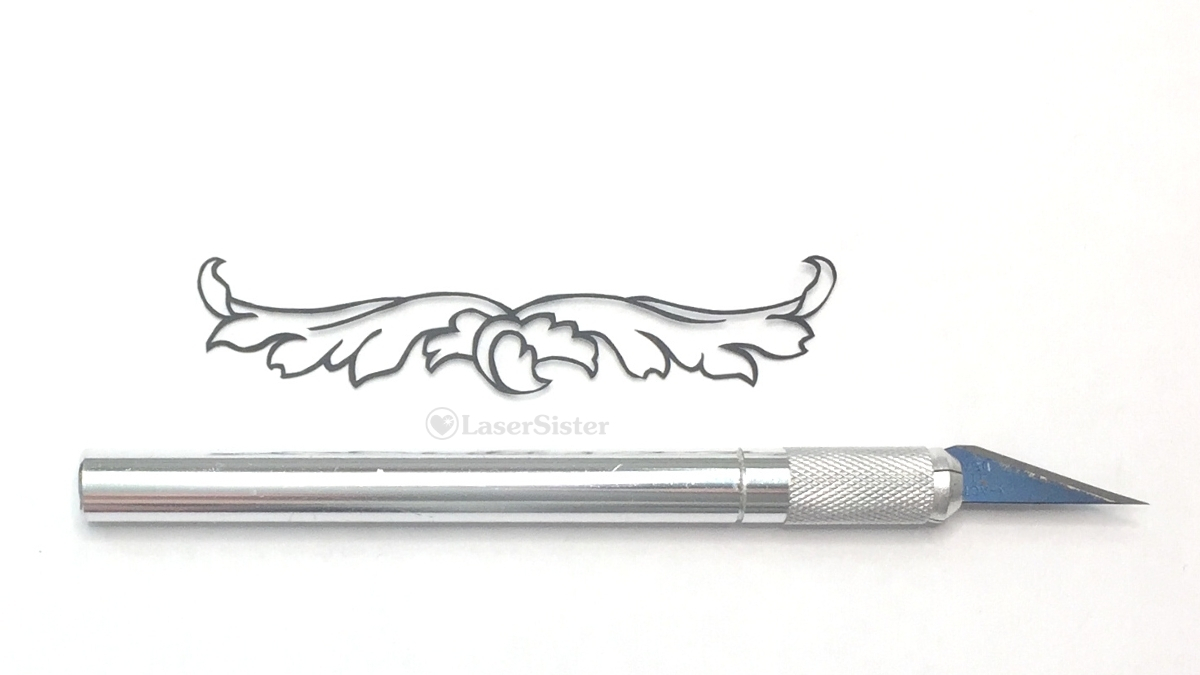
Leaf Wings #625

“Leaf Wings” is from an ongoing papercutting project that I’ve been doing. (trying to work my way through all of the designs in the “922 Decorative Vector Ornaments” book by Dover Books.)

Today’s design is number 625 in the book. For once I found it easy to give this design a name. It looks like leaves, and it also looks like wings.

leaf wings papercut with vertical scalpel for scale - Kay Vincent - LaserSister

Closer up:

leaf wings papercut close up - Kay Vincent - LaserSister

I like this Arts & Crafts style design. And the thin lines and curves in it were a good challenge for my developing papercutting skills. I can imagine using this motif as the bottom border for a larger papercut. I think this design is in my top 10 favourites so far, of all of the 400+ cuts that I’ve adapted and cut from that book of designs.


In the background I’ve been listening to yet another audiobook from the library. This one is Duskfall by Christopher Husberg. I’m only at the beginning so I haven’t decided yet whether I like the book or not. At least I’ve finished The Blacksmith Queen, now. I think the worst thing about that one was that the narrator sounded like she was gulping air between every sentence. Very offputting.


Any comments? You can chip in via the comments page, or Facebook, Twitter, LinkedIn or Instagram.

Posted on Leave a comment

Lockdown Papercutting Project Day 65: Ornate Leaf Border

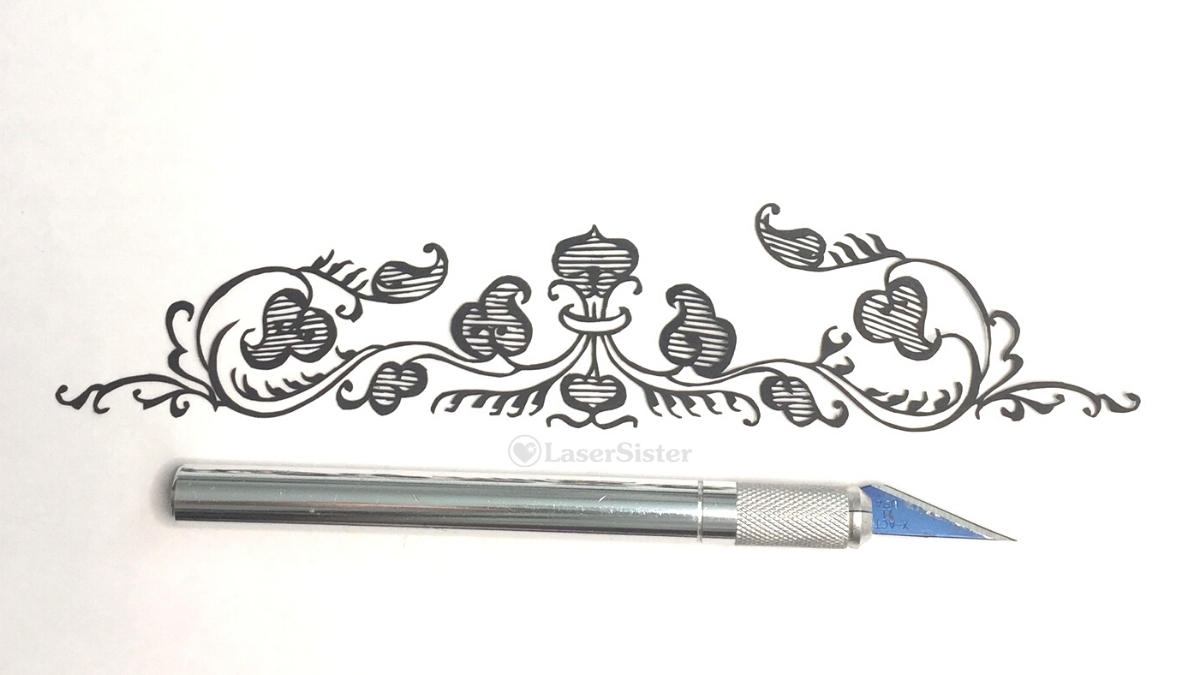
ornate leaf border papercut - horizontal with scalpel for scale - Kay Vincent - LaserSister

Ornate Leaf Border #626

“Ornate Leaf Border” is from my ongoing papercutting project (where I’m trying to work my way through all of the designs in the “922 Decorative Vector Ornaments” book by Dover Books.)

This week’s design is number 626 in the book.

ornate leaf border papercut with vertical scalpel for scale - Kay Vincent - LaserSister

Closer up:

ornate leaf border papercut close up - Kay Vincent - LaserSister

As usual it was difficult to come up with a new name for yet another leafy design, but what the heck – the design looks pretty fancy and could be a border.

This one was very challenging to cut, what with all of the teeny tiny ‘shaded’ lines in it. It was also extremely difficult not to rip, because it’s so big and has such thin lines, and they all start from the same central point. At first glance it looks like I’ve done a pretty good job of the cutting, but if you look at it for long enough then you’ll see that some little bits have accidentally fallen off while I’ve been cutting it. Oops. It’s also not completely symmetrical, but I can’t remember if that was due to my inaccurate cutting or if the design was meant to be that way. I do still like it, though. It’s one of the longest and most difficult cuts that I’ve made.


Any comments? You can chip in via the comments page, or Facebook, Twitter, LinkedIn or Instagram.

Posted on Leave a comment

Lockdown Papercutting Project Day 64: Orange Tree

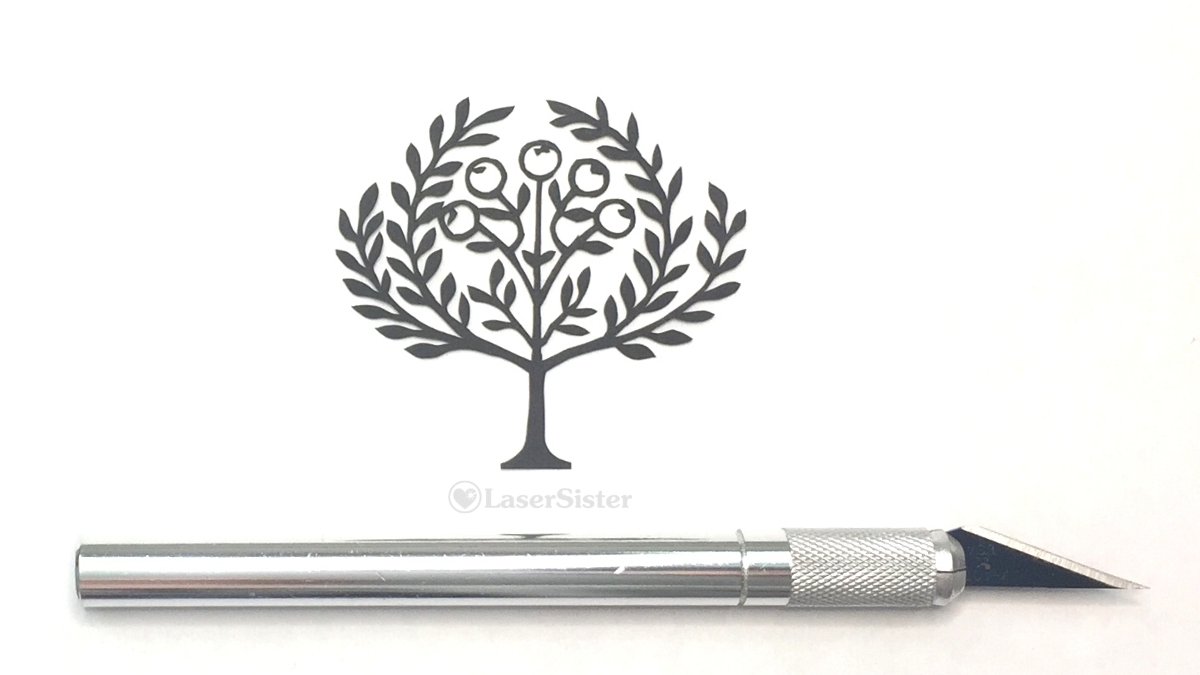
orange tree papercut - horizontal with scalpel for scale - Kay Vincent - LaserSister

Orange Tree #627

“Orange Tree” is from the ongoing papercutting challenge that I’ve been doing. (Basically I’m trying to work my way through all of the designs in the “922 Decorative Vector Ornaments” book by Dover Books.)

Today’s design is number 627 in the book. I have no idea whether those round things are oranges or not, to be honest, but I had to call it something.

Closer up:

orange tree papercut close up - Kay Vincent - LaserSister

Maybe it’s an olive tree? But in that case, those are big olives. It also looks a bit like a laurel wreath, but in that case, what are those fruits?

Even if it’s not a specific tree/fruit, I still like this motif. Basically I’m just a sucker for plant-based, Art Nouveau-type designs.

I enjoyed cutting this one, and I’m pretty happy with the result. There are a couple of bits that I’m tempted to neaten up a bit more, but overall I like it.


In the background today I’ve been listening to The Self Publishing Podcast. This show is so useful…all I have to do now is finish my book!

Do you know what the plant could be? Do you dis/agree that it’s an orange tree? Feel free to chip in via the comments page, or Facebook, Twitter, LinkedIn or Instagram.

Posted on Leave a comment

Lockdown Papercutting Project Day 63: Lily of the Valley2

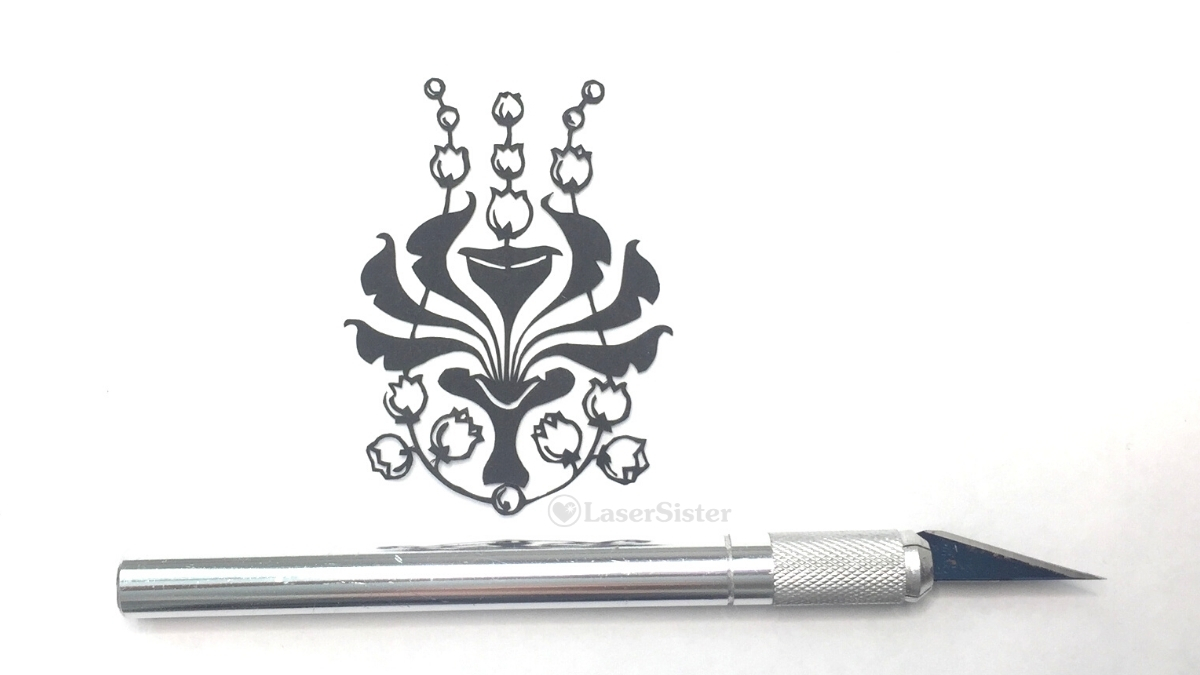
lily of the valley2 papercut - horizontal scalpel for scale - Kay Vincent - LaserSister

Lily of the Valley2 #630

This “Lily of the Valley2” design is from the ongoing papercutting challenge that I’ve been doing. (Basically I’m trying to work my way through all of the designs in the “922 Decorative Vector Ornaments” book by Dover Books.)

Today’s design is number 630 in the book.

lily of the valley2 papercut - vertical scalpel for scale - Kay Vincent - LaserSister

Closer up:

lily of the valley2 papercut close up - Kay Vincent - LaserSister

The strange thing about this one is that my eyes don’t find it anywhere near as offensive as Day 62’s Lily of the Valley design. And yet they share so many features. Theoretically this one should give me the same feeling, if it was the combination of the thick and thin elements that bothered me. But to my eye this version has more ‘balance’ to it, somehow.

In terms of cutting skills, this one was also more challenging. It was harder to adapt as a papercutting design, and had even more thin lines, and those little round buds were surprisingly difficult to cut.


Meanwhile…

In the background I’ve been listening to another audiobook; The Blacksmith Queen, by G.A. Aiken. I love a good fantasy book, me. But I’m having multiple problems with this one. It turns out that I have an issue with centaurs. One of my main problems is: What do they eat? If they eat grass, then why are their teeth configured like humans’ teeth and not horses’ teeth? And how the hecky peck do they reach the grass? But if they’re omnivores, then what do their digestive tracts look like, and what kind of poos do they do? And in either case, how much would they have to eat in order to keep those great big bodies fed?

Worse still…

But even worse for me in this case is that the ones in the book are shapeshifting centaurs. How can that possibly work? If they’re in human form and suddenly shift into centaur form, then where does all of that extra bulk of their bodies come from? Where do all of the bones and flesh and horsehair go while the centaurs are in their human form? OR, if their natural form is a centaur and they are just magically projecting some kind of glamour that makes people see them as human, then (1) how many of them could fit into a normal-sized room (because their invisible rest-of-body is presumably still there, but just can’t be seen because of the glamour), and (2) wouldn’t their heads still be 5-ish feet above normal human height, and so the glamour would have to not only take their shape into account but also their position? Oh yes, and (3) if they go through a door then they must have to duck their heads right down…so surely that means they have to maintain two completely different bodies at the same time – one is their real (centaur) body, and the other is their human-image body.

I’ve thought of another one as well. (4) If their real form is centaur and the human-form is a glamour image, what happens if someone expects the human to ride a horse?

(Etc…)


Can you give a plausible explanation of how shapeshifting centaurs work? If so, please chip in via the comments page, or Facebook, Twitter, LinkedIn or Instagram.