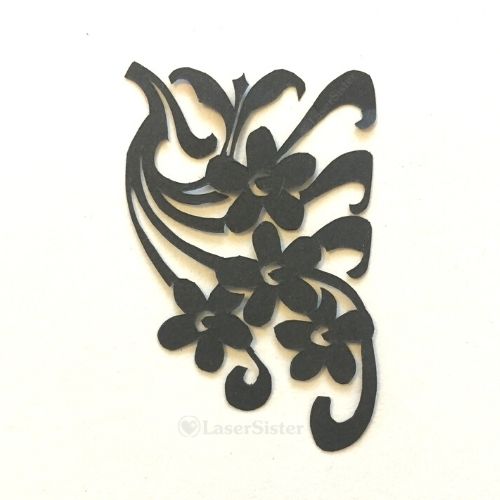
This was a really delicate design, but was surprisingly quick to cut. I would love to use it in a future project, like a very special birthday card or thank-you card or wedding invitation etc.
While cutting it I was listening to an audiobook from the library, Servant of the Crown by Paul J. Bennett. I’m at Chapter 14 so far, and am hoping for an ‘inciting incident’ to happen soon. It reminds me that I’ve got my own half-finished fantasy novel languishing somewhere. Mind you, I should really use my writing time to do my PhD, rather than writing my fantasy novel.
At least all of the above took my mind off bloody Covid19 bloody lockdown bloody measures for a while. I would never have imagined that I would live in a country where the Government banned going to work, going to school, smiling at people, singing, or people hugging their grandchildren or going to their family’s weddings or funerals. This is like some kind of sick nightmare.
Today’s design is number 706 in the book. What the heck would you call that style of design? In the end I decided that it reminded me of a cross between Celtic knotwork and lovely iron gates and railings. So that’s how I ended up with the title “Knotwork Railing”:
Closer up:
I’m really pleased with the way this one turned out. For a start I love the design anyway, but I also managed to cut it so that the lines were quite thin and even, and so that it was pretty symmetrical. And yet (to me, anyway) it still looks hand-cut and not like a machine has just cranked it out.
It’s another design that would probably look really good in a fancy wedding invitation or congratulations card. And the bonus is that it doesn’t take a very long time to cut. Yet another reason to love this design.
The reason I love this design is that it combines three of my favourite things. Celtic knotwork, and fancy ironwork. Years ago I got a book out of the library on how to draw Celtic knotwork, and I loved it so much that I then went and bought it.
And whenever I’m out anywhere my attention is always caught by swirly ironwork designs wherever I am. In the case below, I was in Copenhagen:
…and the third of my favourite things is papercutting. So that’s why I liked this particular design so much.
This week’s design is number 702 in the book. I’m seriously running out of titles I can give these 922 designs! Yet another leaf design, and so how do I differentiate it from all of the other leaf designs? Welllll, it’s got a lot of curlicues in the vines, plus the leaf elements are rather curly. So “Curly Leaf” it is:
Closer up:
This is one of my favourites so far. A small, delicate design that presented a real challenge to cut accurately, and very satisfying to look at once it was finished.
I’m already trying to find ways to incorporate this one into a future design. Maybe a fancy wedding invitation card.
I’m still marvelling at how much better my cutting is, now that I’m a few hundred designs into this papercutting challenge. In fact, I’ve just realised that I’ve picked up so many little tips along the way that I’ve compiled a “Top 10 list of papercutting tips“.
In the meantime, while putting together this blog post I’ve been ignoring the ‘real world’ as usual, and have instead been listening to my favourite podcast, “No Such Thing As A Fish“.
As usual I’ve got no idea what kind of flowers are depicted (although some of them remind me of a stylised version of freesias), so to come up with a title I’ve had to describe them in another way. In this case it’s a mini bunch of flowers, so I’m going “flower posy”.
Closer up:
I particularly enjoy the swirling long leaves in this design, but also the flowing simplicity of the whole thing. Very Art Nouveau. I will almost definitely use this scene again in a papercutting one day. It might make a very nice part of a birthday card design.
(Ha – since I noticed a string of consecutive consonants in a word the other day, I am seeing loads more words with four consonants. Like “biRTHDay”.)
Today’s design is number 699 in the book. As usual I’ve had some difficulty coming up with a descriptive-but-unique name for the design. Again, I couldn’t just call it “Flower” because there are a lot of flower designs in the book that I’m working from. And I don’t recognise the flower itself. So I’ve named it after the things that look like spears that are shooting out from it.
Closer up:
I enjoyed cutting this particular design. It might look simple but it was really tricky to keep very thin lines of the ‘spears’, and to cut the curved shapes of the petals. I doubt I’ll be using this design in any further projects, but as always I will keep it in my sketchbook as a record of my papercutting progress.
While updating this post I’ve been listening to The Bestseller Experiment podcast. Wow – they have achieved a LOT in four years. I wonder if I’ll have finished my papercutting project in four years from now?!
Today’s design is number 698 in the book. You would think this would be a very easy design to choose a name for, but there are so many variations of leaves in the book and I can’t call them all “Leaf” because that would get confusing! But as far as I know I haven’t actually called any of them “Leaf Papercut” yet. So this one wins.
And a very nice leaf it is, too. I enjoyed cutting this one. It was quite straightforward and yet provided some challenges in terms of cutting the fine veins.
Closer up:
Therefore this design falls into the 5-ish percent of designs in the book that I can immediately see myself using again in future projects.
Normally I would note here what audiobook or podcast I’ve been listening to today, but today’s background soundtrack has been Rob preparing a meal that may or may not turn out to be fatal when eaten. So this might be my epitaph. Good luck, future me!
He bought four reduced-price red mullet fish a couple of weeks ago on a whim, and put them straight in the freezer (they had already reached their sell-by date). And today he’s defrosted them only to discover that red mullet are usually sold whole, so they still had their guts inside them (I’ve been doing a bit of research here and here, just to double-check whether I’m likely to die of fish poisoning. Just in case you’re wondering, the very clear advice is that whole fish should NOT be frozen without gutting and cleaning them first.)
*** UPDATE ***
I’m not dead. The fish was OK, in the end. But it still doesn’t get past my long-held theory that “fish equals faff” (what with all of the gutting and de-scaling and then picking bones out while eating it). It was accompanied by shallots and bacon-that-Rob-had-accidentally-dropped-on-the-floor-while-it-was-raw, and he washed the meal down with a bottle of wine that we’ve had for at least eight years and neither of us knew where it came from. It was officially “white” wine but was actually browny-yellow. Yuuuum. Still, it made the perfect accompaniment to the equally dodgy food.
Having noted that yesterday’s design was unusual because it contained four consonants in a row, this one does as well! It definitely wasn’t deliberate, either. I could have called it “Wonky Flower”, but that would suggest that it was asymmetrical by accident, when actually it’s part of the design.
Closer up:
Initially it looks like I’ve accidentally cut off the outer petal things and have then tried to just style it out. But if you look at the two inner petal things, the left one is small and the right one is large (etc). So trust me – this is how the design was meant to look!
It’s so asymmetrical that it makes me uncomfortable to look at for too long, for some reason. I feel a fairly strong compulsion to create a mirror image version of it. That way I can (1) regain the feeling of balance, and (2) prove that it’s not me making mistakes in the cutting – it really is designed like that.
In terms of cutting it was actually a fairly quick one, and felt like a satisfying mixture of curvy lines with fiddly inner shapes. So I could actually see myself using this design again, and not just for the OCD-type ‘closure’ compulsion that I would gain from it 🙂
Today I’m still listening to the Writing Excuses podcast. Love it.
This week’s design is number 697 in the book. As I’ve mentioned before, the designs are just given numbers in the book and not names, so I’ve had to come up with my own names for them. I had no idea what to call this one. It’s got a sort of central stylised flower which isn’t immediately recognisable to me. I did try to get some clues from the other plants in the design, but they weren’t obvious either. Maybe they’re corn stalks? (Corn as in wheat, not as in sweetcorn. The definition of “corn” depends on whether you use UK/US English.)
So all I could think of was calling it “Wildflower Meadow”. As soon as I thought of that name, I noticed what a funny word “wildflower” is. It’s got four consonants in a row (LDFL). Surely there can’t be many words in English that have four consonants all mashed together? (I’m not counting words with “Y” in them, by the way (e.g. “hymn”, or “gypsy”)) Now I’m trying to think of other examples…
“Hatchback”. “Pitchfork”. Oh – maybe there are more than I thought!
Closer up:
Either I’m getting better at papercutting, or I’m getting better at forgiving myself for the little mistakes that I make – or maybe a bit of both. But for whatever reason, I find this design quite pleasing.
Having said that, I’m not sure I would use it as part of a ‘real life’ composition. All the same, I’m glad to have added it to my sketchbook full of papercuts. I’ve got a growing collection of these ‘samplers’ now, and I’m actually starting to see some improvement and progression overall. Which is a good thing, because that was the whole purpose of this “Cutting all 922 designs from the book” exercise in the first place.
I used to comment here about what I’d been watching or listening to in the background while I made the actual papercut. But because there’s been a big gap between cutting them and documenting them, I’ve forgotten what I was listening to when I cut most of them. Maybe I’ll carry on noting what I’m listening to, but from today instead of the date that I cut the design.
…In which case, today I’ve been listening to the “Writing Excuses” podcast. I deliberately didn’t listen to it for a few months this year, just so I could binge-listen to it later. And that’s exactly what I’ve been doing today. Series 14 has had some really useful writing advice in it.
Apart from that, I’ve been giving myself a bit of a day off. I’ve been so busy with paperwork and admin and life for the last few months that I’ve run out of steam. Catching up with my papercutting adventure has been very therapeutic.
Wow. A lot has happened since I last updated this blog thing. 2020 just keeps on giving. I managed to carry on the papercutting project through Lockdown and beyond – it was the only thing keeping me sane(ish)! But unfortunately a lot of life stuff then started happening at the same time. So updating the blog dropped a looooong way down my to-do list.
Some of the exciting events included:
Husband put on furlough from (travel-related) job
Husband losing his (travel-related) job of 18 years
Husband’s 87-year-old mother having major health problems but not being able to get help for her because the problems weren’t Covid-related. (Apparently it’s OK for people in the UK to die of cancer or infections or neglect or anything else, just as long as they don’t get Covid.)
Husband getting a new job
Having to move and sell our house
Having to find and buy a new house
Needing to find somewhere safer for mother-in-law to live
Needing to sell mother-in-law’s flat
Death of my lovely PhD supervisor
Replacement lovely PhD supervisor going on maternity leave
Me failing a crucial module of the PhD, so having to switch to part-time and start the whole module again
Five months later…
… and the world is still looking completely insane. But at least my own little corner of it is starting to calm down a tiny bit, this week. So in between filling in the paperwork for buying and selling houses and doing 500-mile round trips to visit the M-I-L, I’m going to try to carry on recording the results of the ongoing papercutting project. (I’m trying to work my way through all of the designs in the “922 Decorative Vector Ornaments” book by Dover Books. I love papercutting and it has provided me with much-needed occupational therapy this year, and has helped my mental health.)
But now because of the 5-month break since my last post I’m not sure if I should be on “Day 35” or if I should start again or even dump the whole numbering system. Maybe I’ll just carry on with the day-numbering system (because I was still cutting the pieces during those days, even though I wasn’t putting them on social media). And I’ll definitely carry on with the actual design numbers as they are mentioned in the book…
For the majority of these designs I think, “I enjoyed cutting this design, but I’m not sure I’d ever use it in another artwork”. But this one is different. I like the simple leafy design, and because it uses repeating elements it can be made as long or as short as necessary, just by adding or removing leaves from the design.
And again for most of the designs, I think “Aargh – the mistakes are jumping right out at me and taking my attention.” But I’m actually quite pleased with this one.
“Flower and Leaf Border” is from the papercutting project that I’ve been doing for the last few years (trying to work my way through all of the designs in the “922 Decorative Vector Ornaments” book by Dover Books.) But for the period of Covid19 Lockdown, I’ve put the project into overdrive and have decided to adapt and cut 100 designs in 100 days.
Today’s design is number #684 in the book.
It’s another ‘inverted’ design, where I’ve cut holes out of white paper, instead of cutting a silhouette shape out of black paper. So here the black parts of the design are just parts of a black notebook cover that are showing through the holes in the white paper. If I’d put the white paper on top of my hand, then the flowers and leaves would be showing through as hand-coloured.
Closer up:
Here is a close-up of the top section of the design…
…and here is a close-up of the bottom section:
I’m never really as keen on these negative papercuts as I am on the positive ones. Maybe I should work harder on adapting the designs so that they can be created in a positive silhouette form. However, I’m not sure how I could do that effectively with the flower parts of this design. The little circles would have to be much bigger, I think, and would definitely all need to be linked together somehow.